My First CalHacks: What 36 Hours at Berkeley Taught Me
CalHacks at UC Berkeley was the largest hackathon I'd ever attended. 36 hours of building, no sleep, and the most compressed learning experience.


CalHacks at UC Berkeley is one of the largest collegiate hackathons in the world. Thousands of participants. Corporate sponsors. Judges from major tech companies. Prize pools that make the event feel significant, not just fun.
My first CalHacks was a shock. Not because of the scale (I'd been to hackathons before). Because of the intensity. The caliber of participants. The speed at which teams executed. And the realization that 36 hours of focused building produces more learning than a month of tutorials.
The Environment
CalHacks takes over multiple buildings on Berkeley's campus. Long tables, power strips, whiteboards, monitors. Sponsor booths with APIs, hardware, and mentors. A steady supply of energy drinks, pizza, and snacks. Sleeping bags tucked under desks for the few who manage to sleep.
The energy is electric. Not in a motivational-poster way. In a literal, physical way. At 3 AM, most of the world is sleeping. At 3 AM at CalHacks, hundreds of people are coding, debugging, arguing about architecture, and pushing to finish. The collective focus is palpable.
This environment does something that solo building doesn't: it creates urgency without consequences. The deadline is real (you demo in 36 hours or you don't). But the stakes are low. If your project fails, you learn and go home. This combination of real pressure and low stakes is the ideal condition for learning.
What I Built
Our project was a tool that used natural language processing to analyze border crossing patterns and suggest optimal crossing times. A more sophisticated version of what BorderBot was doing, combining NLP from social media reports with historical data.
The technology was ambitious for a hackathon: a web scraper for social media mentions of border conditions, a basic sentiment analysis pipeline, and a frontend that displayed recommended crossing windows.
We got about 70% of it working. The scraper worked. The sentiment analysis was rough but functional. The frontend displayed results. The recommendation engine was mostly hardcoded fallbacks because the NLP wasn't accurate enough to drive real recommendations in 36 hours.
This is the typical hackathon outcome: an impressive demo that's 30% real and 70% illusion. The judges see the demo. They don't see the hardcoded data, the error handling that consists of console.log statements, and the deployment that only works on one person's laptop.
Lesson 1: Scope Ruthlessly
The number one reason hackathon projects fail is scope. Teams try to build too much. They plan a full platform when they should plan a demo.
Our team initially scoped a complete border intelligence platform: historical analysis, real-time predictions, social media integration, multi-crossing support, push notifications. After an hour of planning, we cut it to one crossing, one data source, one prediction model, one simple frontend.
Even with that reduction, we barely finished. The scope that feels "minimal" at the start is always larger than you think once you start building.
The scoping skill transfers directly to product building. Every feature I spec for my products goes through the same filter: "What's the minimum version that demonstrates the value?" Not the minimum viable product, but the minimum demonstrable value. The distinction matters because "viable" implies completeness, while "demonstrable" implies just enough to prove the concept.
Lesson 2: Teams Optimize for Skills, Not Ideas
The best hackathon teams I observed weren't the ones with the best ideas. They were the ones with the best skill distribution.
A team needs: someone who can build a functional backend quickly, someone who can create a presentable frontend quickly, someone who can handle data/ML if the project requires it, and someone who can present compellingly at the demo.
Teams that had four brilliant backend developers struggled because nobody could build the frontend or the demo. Teams with one solid full-stack developer and one great presenter outperformed teams that were technically superior.
This observation shaped how I think about founding teams. When I evaluate partnerships, I look for complementary skills, not complementary ideas. Two people with the same skills compete internally. Two people with different skills multiply each other.
Lesson 3: Demo Skills Are Product Skills
The hackathon demo is three to five minutes of presenting your project to judges. In those minutes, you need to:
- Explain the problem clearly
- Show the solution working
- Highlight the technical complexity
- Articulate why it matters
This is identical to a product launch. A landing page needs to explain the problem, show the solution, highlight differentiation, and articulate value, all in the time it takes a visitor to scroll.
The teams that won at CalHacks weren't always the ones with the best technology. They were the ones who told the best story about their technology. The demo narrative (problem, solution, proof, impact) is the same narrative that sells products.
I now treat every product launch like a hackathon demo. What's the problem? What's the solution? Show it working. Explain why it matters. If I can't tell that story in three minutes, the product isn't ready, not because the technology isn't finished, but because the value proposition isn't clear.
Lesson 4: Sleep Deprivation Reveals Priorities
By hour 24, you're exhausted. The code is messy. Bugs are piling up. The demo is in twelve hours. Your brain is foggy and your judgment is impaired.
This is when you discover your real priorities. The features that seemed essential at hour 1 get cut at hour 24. The polish that felt necessary becomes unnecessary. The architecture that was "correct" gets replaced by whatever works.
Sleep deprivation is a terrible way to make decisions in general. But as a prioritization exercise, it's remarkably effective. When you can only build one more thing before the demo, you choose the thing that matters most. That forced choice reveals what you actually care about, and it's often not what you thought.
In my daily building practice, I simulate this prioritization without the sleep deprivation. "If I could only ship one feature this week, which one?" The answer cuts through the noise of roadmaps, backlogs, and feature requests. The one thing that matters most is the thing to build first.
Lesson 5: The Community Is the Prize
I didn't win CalHacks. The prizes went to teams with more impressive projects and better demos. That's fine; the prizes weren't why I went.
The real value was the community. Conversations with other builders at 2 AM over cold pizza. Seeing how teams from Stanford and Berkeley approached problems. Learning about technologies I hadn't heard of from people who used them daily. Meeting potential collaborators, mentors, and friends.
Hackathon communities are self-selecting for builders, people who would rather spend 36 hours coding than doing anything else. That self-selection creates a density of ambition, skill, and energy that's difficult to find elsewhere.
The connections from that first CalHacks led to future hackathon collaborations, product ideas, and professional relationships that persist years later. The 36 hours of building were valuable. The network was more valuable.
The Hackathon-to-Product Pipeline
CalHacks reinforced something I'd been thinking about since building HackIfy: hackathons are the best product incubator available.
The hackathon gives you:
- Forced time constraint that prevents over-engineering
- Real users (judges, other participants) who provide immediate feedback
- A team to build with and learn from
- External motivation (prizes, demos, competition) that pushes you past comfort zones
- Freedom to fail without business consequences
The products that came out of my hackathon experiences (including ideas that eventually became real products) all benefited from this incubation environment. The hackathon doesn't produce finished products. It produces validated concepts and tested prototypes that can become products if the idea has legs.
CalHacks was my first experience at this scale. It wouldn't be my last. The combination of pressure, community, and creative freedom became addictive, the 36-hour sprint that produces more clarity about what's worth building than weeks of planning.
Enjoyed this article?
I write about building products, AI, aviation, and the journey of entrepreneurship. Follow along for more.
Keep reading

Getting Started with Allem SDK: React Hooks for AI, Forms & Auth
Allem SDK is a collection of React hooks for AI chat, form validation, authentication, analytics, and utilities. Here is how to install and use it.

Getting Started with Allem UI: React & React Native Components
Allem UI is an accessible component library for React and React Native with 44+ components, dark mode, and Tailwind CSS v4. Here is how to install and use it.
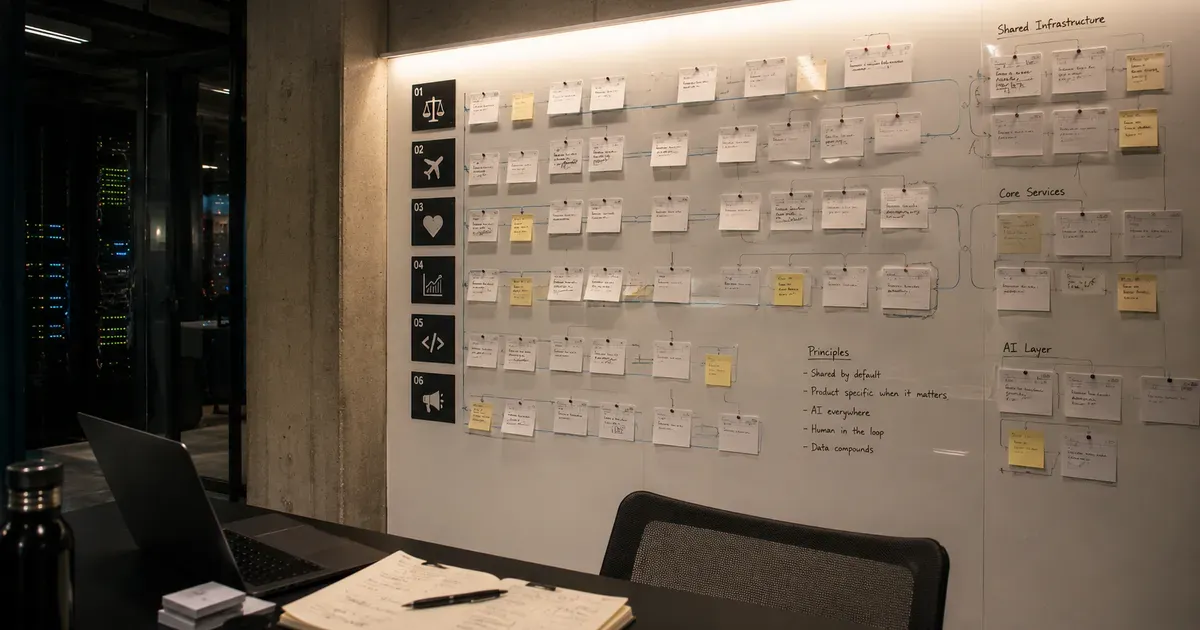
The Agento Suite: Building 6 AI Products in Parallel
In 2026, I launched six AI products across legal tech, travel, healthcare, and developer tools. Here is the architecture and playbook for building in parallel.