The First iOS Electronic Flight Computer: Building Firsts
In 2008, I built one of the first electronic flight computers for iOS, a digital E6B. It taught me that being first matters less than being right.

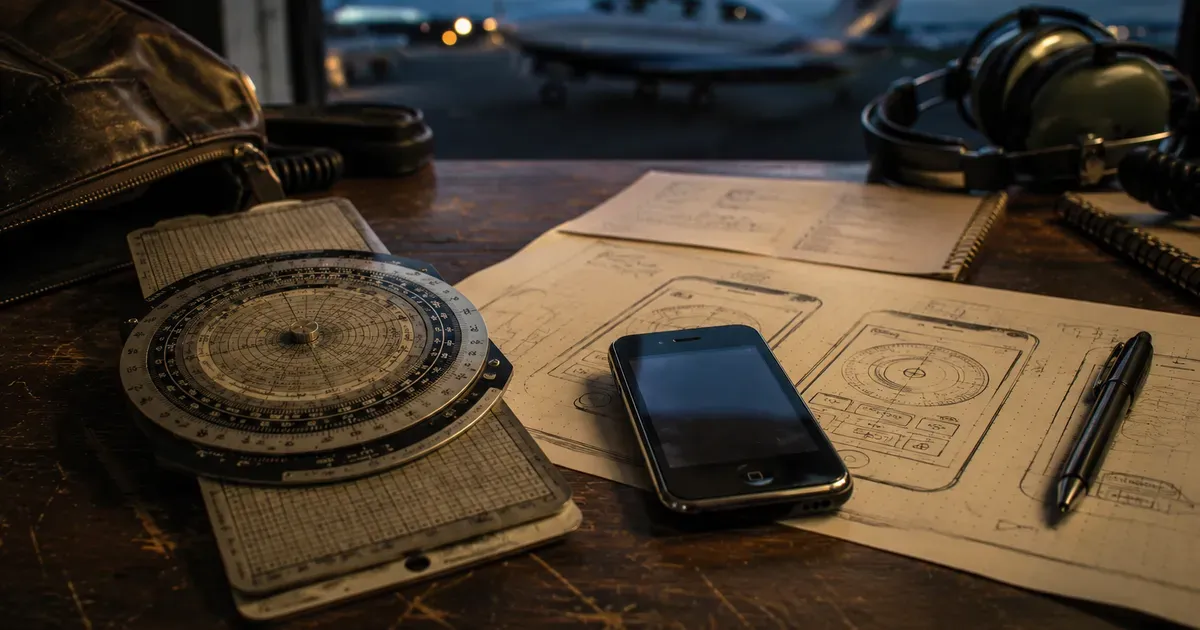
Every pilot knows the E6B.
It's a circular slide rule, two discs of aluminum or plastic that rotate against each other to solve flight planning calculations. Wind correction angles. Fuel consumption. True airspeed. Density altitude. Time-speed-distance problems. Pilots have been carrying them since the 1940s.
In 2008, most student pilots were still using the physical version. Some flight schools required it. Some aviation authorities tested students on it. And even pilots who never touched the physical E6B needed to understand the calculations it performed, because those calculations happen on every flight.
The existing digital tools were bad. Desktop software that looked like it was built in 2003. A few mobile apps that were essentially static calculators: plug in numbers, get an answer, with no context for why the answer matters or how it connects to your flight plan.
I was a student pilot at Giulio Cesare High School studying for my license. I was also learning to build iOS apps. The opportunity was impossible to ignore.
Building the E6B for a Touchscreen
The physical E6B is a masterpiece of analog design. Two rotating discs with logarithmic scales that, through the magic of mechanical computation, solve complex aviation equations without electricity.
Translating that to a touchscreen was a design challenge, not just an engineering one.
The obvious approach (and the one most competitors took) was to build a calculator. Input fields for wind speed, wind direction, true airspeed, and heading. Press calculate. Get a number.
That's technically correct. It's also useless for learning.
Student pilots don't just need the answer. They need to understand the relationship between the variables. They need to see how changing wind speed affects ground speed. They need to develop intuition about wind correction angles that they can apply in real time, in a cockpit, without pulling out their phone.
So instead of building a calculator, I built an interactive flight computer. The dials rotated on screen, just like the physical E6B. You could drag the wind correction angle and see the ground speed change in real time. The relationship between the variables was visible, not hidden behind a calculate button.
It was harder to build. It required custom graphics, touch gesture handling, and mathematical models that rendered smoothly at 60 frames per second on the hardware of 2008. But it was the right product for the audience: student pilots who needed to learn, not just calculate.
Why Being First Is Overrated
I built one of the first electronic flight computers for iOS. And I learned that being first is both less valuable and more valuable than people think.
Less valuable because first-mover advantage in niche markets is weak. The aviation app market is small. There are no network effects. No viral loops. Being first doesn't create a monopoly. It creates awareness that the product category exists, which helps your competitors as much as it helps you.
Within a year, several other E6B apps appeared on the App Store. Some were simpler. Some were cheaper. Some were free. Being first gave me a head start, but it didn't give me a moat.
More valuable because being first forces you to solve problems nobody has solved before. There were no design patterns for "interactive flight computer on a touchscreen." No open-source libraries for aviation calculation rendering. No user research to reference. Every decision was original.
That forced learning is the real value of being first. Not the market position, but the depth of understanding you develop when you can't copy anyone else's homework.
The Calculations Behind Every Flight
For non-pilots, here's what the E6B actually does, and why it matters enough that I built an app for it.
Wind correction. An airplane doesn't fly through the air like a car drives on a road. It flies through a moving air mass. If you want to go north but the wind is blowing from the west, you have to point the airplane slightly into the wind (a wind correction angle) to maintain your desired track. The E6B calculates that angle.
True airspeed. The airspeed indicator in a cockpit shows indicated airspeed, which is affected by altitude and temperature. True airspeed (how fast you're actually moving through the air) requires a correction. The E6B solves that correction.
Fuel planning. How much fuel do you need? That depends on distance, ground speed (which depends on wind), fuel consumption rate (which depends on altitude and power setting), and required reserves (which depend on your aviation authority's rules). The E6B connects these variables.
Density altitude. The performance of an aircraft depends on air density, not just physical altitude. Hot, high, humid conditions reduce air density, which reduces engine performance and wing lift. Density altitude is the altitude the aircraft "thinks" it's at. Miscalculating it has killed pilots.
Every one of these calculations happens before every flight. Professional pilots use avionics and flight planning software. Student pilots need to understand the math. The electronic flight computer bridges that gap, teaching the concepts through interaction rather than memorization.
From E6B to Aviation Infinity
The flight computer was my first aviation product. Within months, it became clear that the flight computer was a feature, not a product.
Student pilots needed the E6B calculations, but they also needed question banks, study plans, progress tracking, meteorology references, air law summaries, and practice exams. The flight computer was one tool in a larger toolkit.
That realization led to Aviation Infinity, a platform that incorporated the flight computer into a complete learning system. The E6B became one module among many, connected to the same adaptive learning engine that powered the exam prep.
This is a pattern I've seen repeat across every industry: the first product you build shows you the real product you need to build.
The flight computer showed me that pilots needed a learning platform. Aviation Infinity showed me that flight schools needed a management system. The management system showed me that the industry needed Avioyx, a complete aviation operating system.
Each product is a stepping stone to a deeper understanding of the industry. You don't see the full picture from outside. You see it by building, shipping, getting feedback, and building again.
Lessons from Building Firsts
The flight computer was small, a single iOS app that solved a specific problem. But the lessons scaled:
Solve the learning problem, not just the calculation problem. A calculator gives answers. An interactive tool teaches understanding. The extra effort to build the interactive version was the difference between a commodity app and a product people remembered.
Niche markets reward depth over breadth. I could have built a general aviation app that did ten things adequately. Instead, I built the best flight computer available. That reputation ("the best at this one thing") opened every door that followed.
The first product is research. Don't expect the first product to be the business. Expect it to teach you what the business should be. The flight computer taught me what pilots actually needed, which was infinitely more valuable than the revenue it generated.
Users in regulated industries want accuracy, not features. Every feature request I received boiled down to the same thing: "Is this calculation correct?" Not "can you add dark mode?" Not "can you make it prettier?" Correctness was the only feature that mattered.
Building physical tools digitally requires respecting the original. The physical E6B works because generations of pilots refined it. Translating it to a screen without understanding why each element exists would have produced a worse product. Respecting the original design (the rotating dials, the logarithmic scales, the visual relationship between variables) is what made the digital version feel right.
The flight computer was a small product in a small market. It made modest revenue and had modest user numbers. But it was the first domino. Without it, I never build Aviation Infinity. Without Aviation Infinity, I never understand regulated industries deeply enough to build AI products for legal and healthcare.
Every big thing started as a small thing that someone bothered to build.
Enjoyed this article?
I write about building products, AI, aviation, and the journey of entrepreneurship. Follow along for more.
Keep reading

New Pilot Shop & Want To Be a Pilot: Niche Communities
I built an aviation e-commerce store and a pilot mentoring platform for tiny markets. Small communities with deep needs are more valuable than large, shallow ones.

Building for 33 Aviation Authorities Taught Me Regulated AI
Most AI startups avoid regulated industries. Here is what a decade inside aviation, legal, and healthcare taught me about building AI that must be right.

The Aviation Portfolio: How Five Products Serve One Industry
Inside the strategy behind building five complementary products for the aviation industry. Aviation Infinity, Avioyx, AvioSharing, New Pilot Shop, and Want To Be a Pilot.