পণ্য নির্মাণ, AI, এভিয়েশন এবং উদ্যোক্তার যাত্রা নিয়ে লেখা।
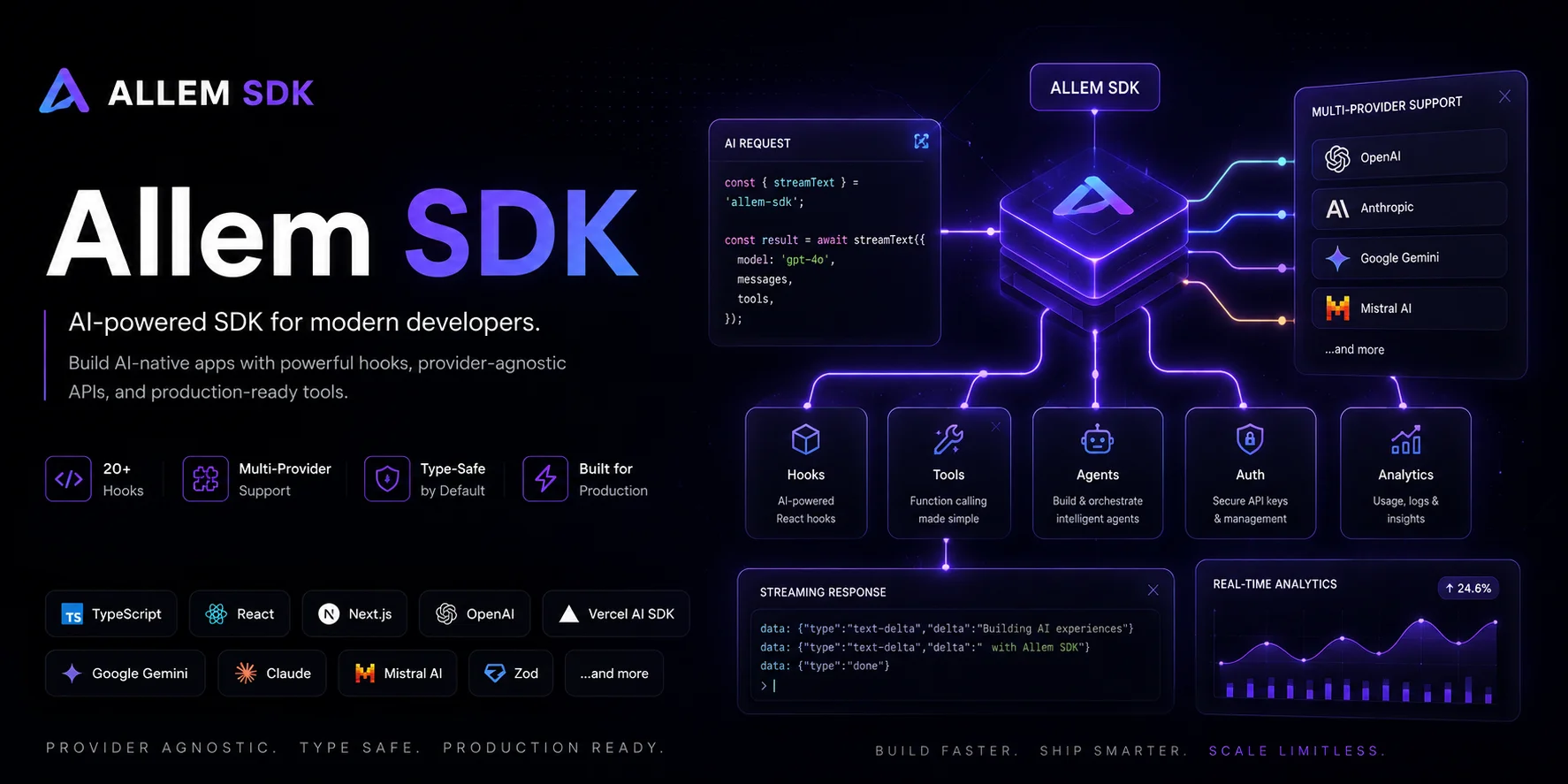
Allem SDK is a collection of React hooks for AI chat, form validation, authentication, analytics, and utilities. Here is how to install and use it.
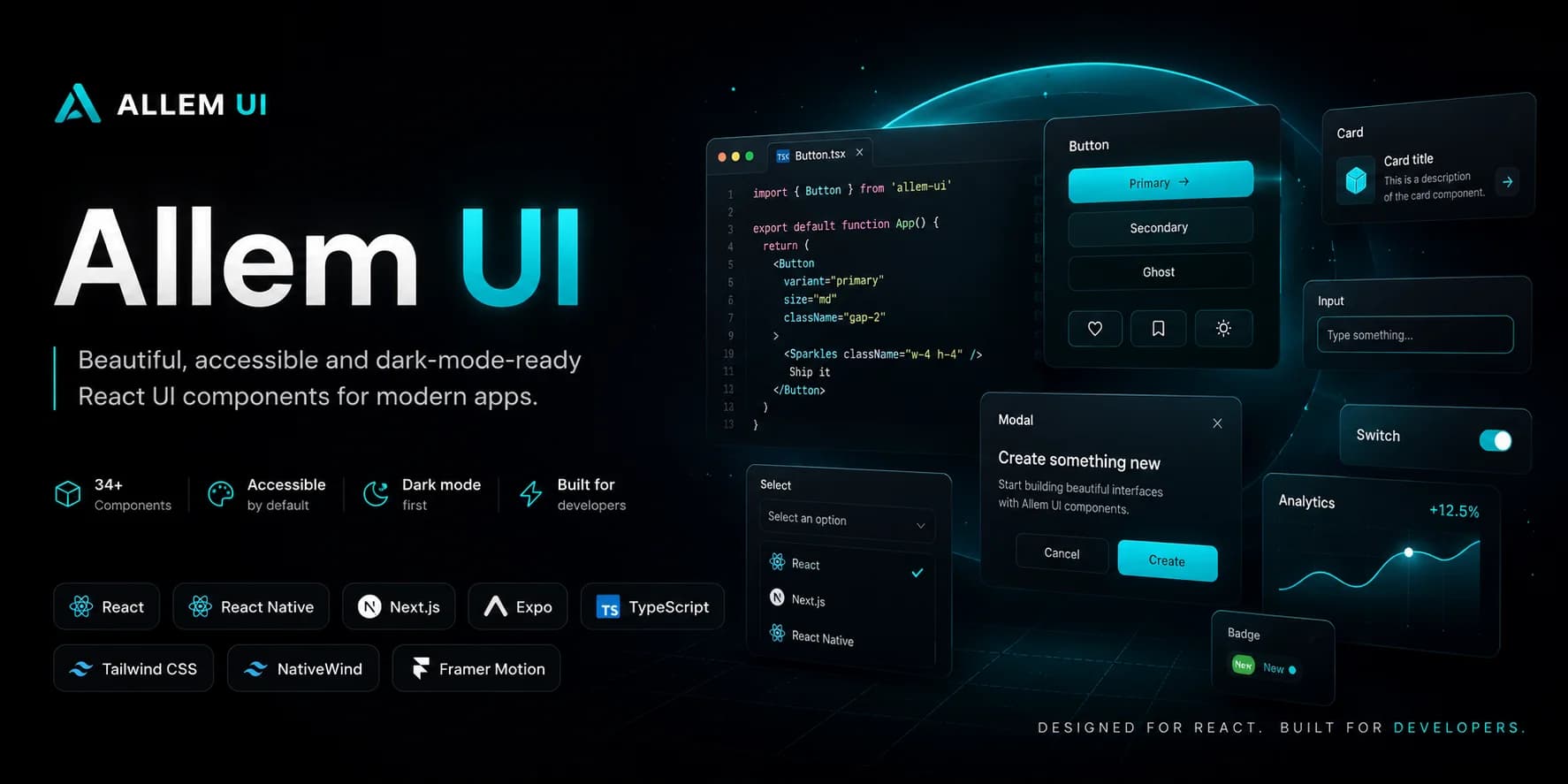
Allem UI is an accessible component library for React and React Native with 44+ components, dark mode, and Tailwind CSS v4. Here is how to install and use it.
Everyone builds AI for consumer apps. The real challenges and opportunities are in industries where mistakes have consequences: aviation, legal, healthcare.
80% of Americans with civil legal problems can't afford an attorney. Unbundled legal services is the solution the industry ignored. We built the AI marketplace.
I built an aviation e-commerce store and a pilot mentoring platform for tiny markets. Small communities with deep needs are more valuable than large, shallow ones.
In 2026, I launched six AI products across legal tech, travel, healthcare, and developer tools. Here is the architecture and playbook for building in parallel.
Surfyx is a surf tracking app and social network. Building it taught me that distribution, not features, determines whether a product succeeds in a niche market.
Most AI startups avoid regulated industries. Here is what a decade inside aviation, legal, and healthcare taught me about building AI that must be right.
I maintain ~20 products solo. AI is not replacing my work, it is multiplying it. Here is how I use Claude and AI tooling to operate at impossible scale.
How eight months of research became a working prototype. the technical decisions, the surprising challenges, and the first user reactions to AI-guided legal help.
The legal industry is where healthcare was twenty years ago. Unbundled services powered by AI are the path to making legal help affordable.
Mapping the 2024 legal tech market revealed a crowded enterprise layer, a thin consumer layer, and three critical gaps that AI-powered tools can finally close.
Why I am designing an AI coding assistant that understands entire product portfolios, not just individual files, and the specific problems it needs to solve.
What I learned about designing legal software as someone who has never practiced law, and why outsider perspective might actually be an advantage.
A solo founder's analysis of the legal tech market. who is building what, who is being served, and where the biggest opportunities for AI remain untouched.
The story of how Risely stumbled into product-market fit through an audience I never designed for, and what it taught me about building with loose hands.
The thesis behind building specialized AI agents for law, coding, and beyond, and why general-purpose AI tools leave so much value on the table.
The research phase behind LegalAgento. understanding why 80% of civil legal needs in the US go unmet and how AI-powered unbundled legal services could change that.
From aerospace engineering to AI platforms across aviation, legal tech, and travel. What 18 years of shipping taught me about problems worth solving.
I've won 10+ hackathons across 4 countries. The secret isn't coding fast, it's deciding fast. Here's the framework I use every time.
Inside the strategy behind building five complementary products for the aviation industry. Aviation Infinity, Avioyx, AvioSharing, New Pilot Shop, and Want To Be a Pilot.
Pilots use a different app for every task. Avioyx combines flight planning, weather, logbooks, and scheduling into one OS for every major authority.
ClickAi orchestrates multiple AI agents for structure, copy, design, and SEO to produce coherent websites. Here's how the system works.
Aerospace engineering in Rome, flight training in Belgium, building in Mexico and the US. Each move reshaped how I think about users.
Studying aerospace engineering in Rome, researching at MIT, flight training in Belgium, building in Mexico and the US. each move reshaped how I think about problems, users, and what 'good enough' means.
I built an MCP server that lets Claude publish to my blog directly. Here's the full architecture, tools, MongoDB integration, and lessons learned.
10+ wins across Italy, Spain, Mexico, and the US for Google, Facebook, ForeFlight, and Whirlpool. Hackathons taught me to ship under impossible deadlines.
I've built products in Italy, Belgium, Mexico, the US, the UK, and for users in 120+ countries. Speaking 7 languages and working across cultures taught me that localization isn't translation. it's a completely different way of thinking about products.
Products in Italy, Belgium, Mexico, the US, the UK, for users in 120+ countries. Localization is not translation, it is a different way of thinking.
In 2008, I built one of the first electronic flight computers for iOS, a digital E6B. It taught me that being first matters less than being right.
Surfyx is my first product as a co-founder. Here is why I built a social network for surfers and what building for a passionate community taught me.
Lead mentor at UC Berkeley's CalHacks since 2018. Watching thousands of students build AI in 36 hours taught me more about tech's future than any conference.
How I identified the gap in flight operations software and began designing Avioyx, a platform built for how modern flight schools actually operate.
Entrepreneurs spent weeks and thousands on websites that could be generated in minutes. Seven years later, ClickAi builds live sites from a voice prompt.
A student pilot struggling with outdated materials across 33 authorities. So I built the first AI flight academy, now serving 50,000+ students globally.
From aerospace engineering at MIT to building AI platforms across aviation, legal tech, travel, and education. here's what 15 years of shipping products taught me about finding problems worth solving.
MCP servers connect AI models to your real systems - databases, CRMs, deployment pipelines. Here's why I built custom MCP servers and what they changed.
The full arc from my first side project to a portfolio of 9 products. what changed, what stayed the same, and what I wish I'd known at the beginning.
A year of building with AI at the center: integrating Claude across my products and learning what it means to collaborate with AI daily.
Edge computing with Next.js isn't always faster. Here's where it genuinely helps and where it's counterproductive in production.
What it takes to build AI products that people actually trust in high-stakes, regulated environments like law. transparency, boundaries, and honest uncertainty.
The systems, boundaries, and hard-learned lessons that let a solo founder keep 9 products alive and growing. without working 80-hour weeks.
The systems, boundaries, and hard-learned lessons that let a solo founder keep 19 products alive and growing. without working 80-hour weeks.
Practical Vercel AI SDK patterns for production: streaming responses, tool calling, and structured output that actually parses. From real shipped code.
How I structure a TypeScript monorepo across 9 live products - shared packages, independent deployments, and the patterns that prevent a monolith.
After testing both extensively in production across my products, here is why Claude powers all of my AI features, and the specific technical reasons behind the choice.
After building AI products across multiple industries, here is why I believe vertical AI wins, and why most horizontal AI startups will struggle to survive.
A practical breakdown of what AI agents actually are, how they differ from chatbots and copilots, and why they represent the next major shift in software.
Looking back on seven years of building web products, from Rome to the world, from first lines of code to 50K users. The advice I wish I had heard at the start.
After seven years as a solo founder building multiple products, I have strong opinions about when to stay alone and when to partner up.
Aviation Infinity just crossed 50,000 students. Here is the unfiltered story of how a side project became a real education platform.
A year of building AI products has given me a collection of expensive mistakes. Here are the five that cost me the most time, money, and sanity.
Everyone says to add a vector database to your AI app. But do you actually need one? I tried it in 2 products - one was right, one was overkill.
After building both open-source tools and paid SaaS products, I have developed a framework for deciding which model to use.
Building AI for aviation taught me that compliance is not a constraint on innovation. It is a design requirement that shapes better products.
Next.js auth patterns that survived real users, security scans, and 3 AM incidents - JWT, HTTP-only cookies, and refresh token rotation.
Growing up in Rome gave me something that no computer science degree could: a deep appreciation for craftsmanship, beauty, and things that last.
Generating content with AI is easy. Generating content that is consistently good enough to ship is a completely different problem.
Aviation Infinity was built to help pilots pass their exams. Adding AI-powered adaptive learning transformed it from a question bank into a personal flight instructor.
Playground prompts fail in production. Here's how production prompt engineering differs - covering consistency, cost, latency, and safety at scale.
ClickAi was already an AI website builder. But integrating LLMs transformed it from a template filler into something that genuinely understands what users want.
Integrating LLMs into production apps is nothing like the demos. Here's what I learned shipping LLM features to real users, mistakes included.
I migrated multiple production apps to the Next.js App Router before it was stable. Here are the real growing pains, the wins, and why I'd do it again.
When ChatGPT launched in late 2022, I knew every AI product I had built needed to be rethought. Here is how I approached the rebuild.
After six years of building products as a solo founder, the biggest lesson is that products compound like interest. each one makes the next easier and more valuable.
I'm a developer, not a designer - but I maintain consistent UI across 6 products. Here's how building a design system as a solo founder works with Tailwind.
How the idea for AvioSharing was born from a simple observation: flying is expensive, and pilots waste money flying alone when they could share costs.
Translation is only 20% of internationalization. Here's what I learned building for 30+ countries: payments, dates, and culture matter more.
What I learned scaling Aviation Infinity from a side project to a platform serving 25,000 student pilots, and the challenges that came with each milestone.
The pricing experiments I ran across my products, what I learned about willingness to pay, and the counterintuitive results that reshaped my approach.
I run 6 production products and each gets its own database, no exceptions. Here's why a database-per-product strategy beats shared infrastructure.
A breakdown of the content marketing strategy that grew Aviation Infinity's organic traffic, and why most SaaS content advice didn't apply.
Standard multi-tenant SaaS advice assumes a team. Here's how I approach tenant isolation as a solo founder running multiple products.
Why I decided to rebuild ClickAi from the ground up, what I learned about AI product development, and how v2 became a fundamentally different product.
The aviation training industry emerged from COVID fundamentally changed. Here's what I saw from inside the market and how it shaped my products.
Five years of building products. Five active products. Multiple countries. Zero employees. Here's the honest retrospective. what worked, what didn't, and what I'd tell someone starting the same journey.
Five years, multiple products, zero employees. An honest retrospective on what worked and what I'd do differently.
New Pilot Milano is an aviation e-commerce store selling pilot uniforms and gear. Launching it alongside my digital products taught me how physical and digital products complement each other in a portfolio.
New Pilot Shop sells pilot uniforms and gear. Launching physical products alongside digital ones taught me how they complement each other.
Most SEO advice assumes a content team and a budget. Here's what actually moves the needle when you're one person building and writing.
Want To Be a Pilot connects aspiring pilots with experienced aviators. Building it taught me mentorship products are supply-constrained and hard to scale.
When strangers transact through your platform, trust is the product. Building Babonbo's safety systems taught me they're the invisible foundation.
I switched from CSS modules and styled-components to Tailwind CSS across every product. Here's why it eliminated naming decisions.
Geographic expansion isn't just translation - it's regulation, payments, and localization. Here's what I learned going multi-country.
Aviation Infinity reached 10,000 student pilots. The growth was institutional: flight school partnerships, word-of-mouth, and content quality.
I've integrated Stripe across 5 products - subscriptions, marketplace payouts, multi-currency. Here are the integration lessons the docs don't teach.
A two-sided marketplace isn't one product, it's two. Here's what Babonbo taught me about balancing supply and demand.
After building from the US-Mexico border and Italy, I moved to London. A global tech ecosystem changed my perspective on markets and ambition.
Families with young children are the most underserved segment in travel tech. The needs are specific, spending is high, and solutions are fragmented.
No supply without demand, no demand without supply. Here's how I solved the cold start problem for Babonbo and what applies to any marketplace.
2020 was supposed to be a growth year. Instead it became a survival year. The lessons are about resilience, adaptability, and the advantage of being small.
I've deployed on AWS, Heroku, and self-managed VPS. Vercel is the first platform where deployment became invisible. Here's why I moved every product to Vercel.
By late 2020, many aviation startups had shut down or pivoted. I doubled down because the pilot shortage was deferred, not gone.
Product-market fit isn't a single moment of revelation. It's a collection of signals - some obvious, some subtle. Here are the ones I watch for.
Converting JavaScript to TypeScript broke everything - temporarily. Six months later it was my best engineering decision. Here's the migration guide I wish I'd had.
New Pilot Shop started as an experiment: premium pilot uniforms, designed in Italy, sold online. Small markets with passionate customers can surprise you.
2020 taught every founder that uncertainty is the default. The products that survived had the most adaptable foundations, not the best plans.
Going serverless with Vercel and MongoDB Atlas eliminated an entire category of work. Here's how I ditched SSH and nginx for good.
COVID forced aviation training online. Students discovered digital tools beat physical classrooms, and Aviation Infinity saw the shift firsthand.
COVID changed my entire product strategy - from single-industry focus to diversified portfolio and from growth at all costs to sustainable operations.
In March 2020, global aviation shut down overnight. Air traffic dropped 90%, flight schools closed, and my primary market evaporated.
I've been building products remotely across time zones for years. The tools matter less than the workflows that keep you productive.
In January 2020, aviation was booming and pilot demand was at record highs. I was expanding Aviation Infinity aggressively. Then March happened.
After three years and multiple products, the compound effect is real: shared code, transferable skills, and a portfolio greater than the sum of its parts.
Aviation taught me that regulated industries need a different mindset. Compliance isn't a constraint to work around - it's a feature to build in.
Running MongoDB at scale across multiple products taught me hard lessons about indexing, aggregation pipelines, and schema design.
You don't need a UX research team to build great products. These feedback loops work for solo founders and small teams.
Most startup advice says focus on one thing. I run multiple products simultaneously. Here's why the portfolio approach works for bootstrapped founders.
No-code vs code isn't an either/or decision. Here's my framework for when Webflow and Airtable beat custom dev - and when they won't.
Aviation Infinity needed thousands of exam questions across fourteen subjects. Here's how I built AI-assisted question generation with expert review.
I've repriced every product I've built. The lessons: charge more than you think, simplify your tiers, and never compete on price in a niche market.
I migrated all my products from React + Express to Next.js. One framework for frontend, backend, and deployment transformed my productivity.
Pilot exam prep was broken - outdated PDFs, no adaptive learning, no mobile. Aviation Infinity was my answer, built by a pilot who suffered through it.
In 2019, AI for web design meant rule-based systems and template matching. It taught me how to build AI products that deliver value even when the AI is primitive.
I built an AI website generator using rule-based systems and design heuristics. Small businesses need websites and can't afford designers. Here's the origin story.
In my second year building products, I learned a counterintuitive truth: shipping faster means building less. Fewer features, simpler architecture, more shipped products.
After building restaurant, travel story, and border crossing tools, I kept seeing the same gap in travel tech: the last mile of traveler experience was unserved.
API-first design produces cleaner architecture, faster iteration, and products that scale. Here's why I design the API before touching the frontend.
Building bilingual products isn't a translation problem - it's a design problem. Here's how I built English/Spanish products that feel native in both languages.
Real-time data pipelines aren't just about speed - they're about staleness, reliability, and trust. Here's what I learned shipping BorderBot's live wait times.
The Node.js and MongoDB stack isn't perfect - it's practical. Here's why I default to this combo for every new product and how it gets me from idea to shipped fast.
Want to win hackathons? It's not about better code - it's about storytelling, scoping, and demo impact. Here's my playbook.
CalHacks at UC Berkeley was the largest hackathon I'd ever attended. 36 hours of building, no sleep, and the most compressed learning experience.
Brojure was a platform for creating visual travel stories. Building it taught me why beautiful products aren't always successful ones.
San Diego isn't Silicon Valley, and that's its advantage. Lower costs, strong universities, and border proximity make it ideal for bootstrapped founders.
BorderBot used machine learning to predict US-Mexico border wait times. My first AI product taught me that data products differ from feature products.
After one year of building web products, I've made every beginner mistake and learned lessons that no tutorial covers. Here are the ten that changed how I work.
After one year of building software products, I've made every beginner mistake and learned lessons that no tutorial covers. Here are the ten that changed how I work.
Living between Tijuana and San Diego means two economies, two languages, and two cultures. That duality shaped how I build products.
Aviation is technologically advanced in the sky and completely analog on the ground. That gap is where I build products.
I decided to use JavaScript for everything: frontend, backend, tooling, and scripting. Here's why one language beats 'right tool for the job' for solo builders.
HackIfy was a platform to discover and organize hackathons. It taught me the difference between a project and a product.
Tijuana has a growing tech scene most people don't know about. Proximity to San Diego and hustle culture make it a quiet startup hub.
My first web startup was a restaurant platform on the US-Mexico border. It failed as a business but taught me product building fundamentals.
My first web app was terrible. Messy code, ugly design, zero users. But it taught me how to ship, the only skill that matters early on.
Flight training is expensive, slow, and unforgiving. The discipline of learning to fly in Italy taught me how to build products under real constraints.
I spent years training to fly airplanes, then started building software. The skills that make a good pilot also make a good product builder.