Two-Sided Marketplace: Supply vs. Demand Strategy Guide
A two-sided marketplace isn't one product, it's two. Here's what Babonbo taught me about balancing supply and demand.


A two-sided marketplace isn't one product. It's two products sharing a platform. The supply-side experience and the demand-side experience have different goals, different UX requirements, and different success metrics.
Building Babonbo made this distinction visceral. The provider dashboard and the family booking flow share a database but almost nothing else. Here's what I learned about managing both sides.
Supply-Side Mechanics
Providers (equipment rental companies and individual parents) need:
Easy onboarding. List equipment quickly. Upload photos. Set prices and availability. The faster a provider can go from "I want to list" to "I'm accepting bookings," the lower the dropout rate during onboarding.
Booking management. See incoming requests. Accept or decline. Coordinate delivery logistics. Track active rentals. The operational dashboard needs to be simple because providers aren't tech-savvy power users. They're parents or small business owners fitting this around their primary work.
Revenue visibility. How much have I earned? When will I get paid? What's my booking history? Financial transparency builds trust and encourages continued participation.
Quality signals. Reviews from families, response time metrics, completion rate. These signals help providers understand how they're perceived and motivate quality improvement.
Demand-Side Mechanics
Families need:
Search and discovery. Find equipment at my destination. Filter by type (stroller, car seat, crib), date, and price. The search needs to feel abundant, and even if supply is thin, the presentation should feel curated rather than empty.
Trust signals. Provider reviews, equipment photos, safety certifications, response rates. Families are renting for their children. Trust requirements are non-negotiable.
Simple booking. Select equipment, choose dates, pay. No twelve-step checkout. No account creation before seeing prices. The booking flow should feel as easy as booking a hotel on Booking.com.
Communication. Message the provider about specific needs. "Do you have a stroller that fits in a compact car?" "Can you deliver to my Airbnb?" The communication channel needs to be reliable and fast.
The Balancing Act
The hardest part of marketplace management is balancing supply and demand:
Too much supply, too little demand: Providers list equipment but don't get bookings. They become discouraged and leave. Empty supply listings make the marketplace look dead to new visitors.
Too much demand, too little supply: Families search but can't find what they need. They leave disappointed and don't return. Unmet demand is wasted marketing spend.
Geographic imbalance: Strong supply and demand in Barcelona but nothing in Lisbon. The marketplace works in some cities and fails in others. Users' experiences depend entirely on their destination.
The balancing strategy: focus expansion on cities where at least one side (usually supply) can be seeded quickly, then market to demand for those specific cities. Never launch a city without adequate supply, because a bad first experience kills the marketplace's reputation in that geography.
The mechanics of two-sided marketplaces are fundamentally different from single-sided products. Every feature, every metric, and every strategy has two versions. The complexity is double. So is the defensibility when it works.
Enjoyed this article?
I write about building products, AI, aviation, and the journey of entrepreneurship. Follow along for more.
Keep reading

Getting Started with Allem SDK: React Hooks for AI, Forms & Auth
Allem SDK is a collection of React hooks for AI chat, form validation, authentication, analytics, and utilities. Here is how to install and use it.

Getting Started with Allem UI: React & React Native Components
Allem UI is an accessible component library for React and React Native with 44+ components, dark mode, and Tailwind CSS v4. Here is how to install and use it.
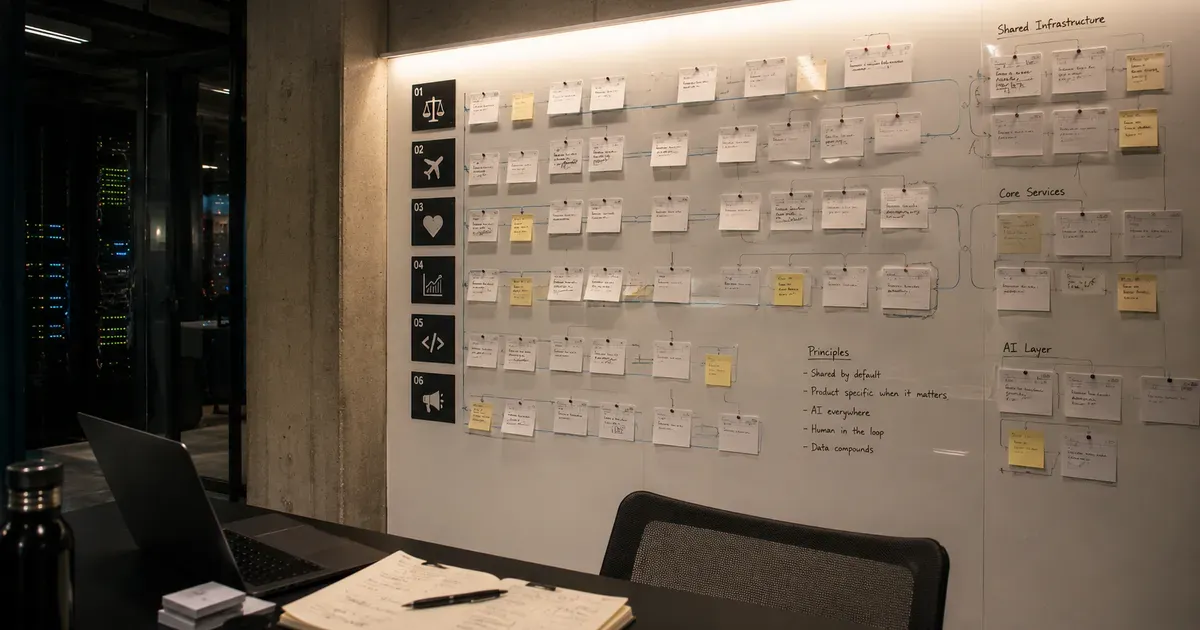
The Agento Suite: Building 6 AI Products in Parallel
In 2026, I launched six AI products across legal tech, travel, healthcare, and developer tools. Here is the architecture and playbook for building in parallel.